


AI app builders can turn a prompt into a polished interface in minutes. You may have navigation, forms, dashboards, and responsive screens before a traditional project has finished its first wire-frame.
But click Sign up, upload a document, or save a customer record and the real gap becomes clear. The screen may exist, while the database, API, identity, file handling, and communication services behind it do not.
Developers can build each of those services from scratch. For many products, however, that means repeating the same backend setup: configure a database, create CRUD endpoints, implement authentication, connect storage, add email delivery, secure uploads, and package everything for deployment.
Introducing Sereni Base
Sereni Base is an open-source, self-hosted backend platform from Aptlogica Technologies. It gives developers a pre-integrated backend foundation built on PostgreSQL, so they do not have to assemble the common stack from scratch for every AI-generated application.
Teams can define their data, get documented REST APIs, connect an existing frontend, and add authentication, storage, email, and file-scanning services from the same modular ecosystem. Sereni Base can be deployed with Docker and connected through raw REST APIs or a TypeScript SDK.
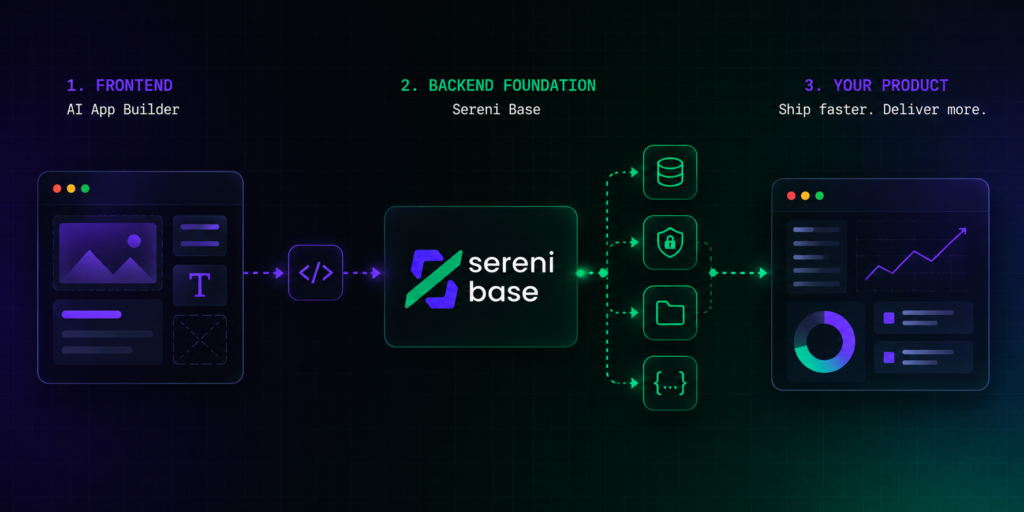
THE WORKFLOW – Create the frontend with your preferred AI app builder. Use Sereni Base for the backend foundation. Keep engineering time focused on product-specific logic, workflows, and user experience.
What your AI-generated frontend still needs
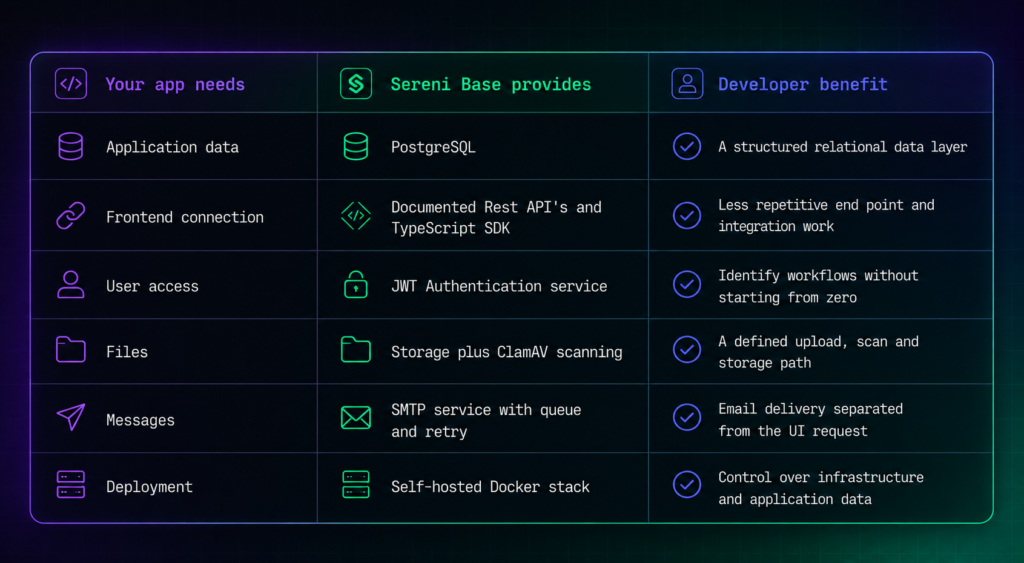
1. Structured data: Real applications need durable data and clear relationships between users, organizations, projects, orders, subscriptions, and files. Sereni Base uses PostgreSQL as its primary database, giving teams a relational foundation for application data.
2. Documented APIs: Every screen needs a dependable way to read and change data. Sereni Base can expose PostgreSQL tables through auto-generated REST endpoints with Swagger/OpenAPI documentation, including common filtering, sorting, and pagination workflows.
3. Authentication and authorization : A login screen is not a security system. The API must identify the user and enforce what that user can access. Sereni Base includes a dedicated JWT authentication service that developers can use as part of the application’s identity and access flow.
4. File storage and safer uploads: Applications that handle documents, images, or attachments need a defined storage workflow. Sereni Base supports S3-compatible, MinIO, and local storage options, with a ClamAV service available for malware scanning before files enter the storage workflow.
5. Transactional email: Verification messages, password resets, invitations, and alerts need more than a frontend button. Sereni Base includes an SMTP email service with queue and retry capabilities, helping separate delivery work from the user request.
6. A deployment model: A browser preview is not an operating environment. Sereni Base is designed for self-hosted, Docker-based deployment, allowing teams to run the backend on infrastructure they control and avoid tying the product to a single hosted platform.
How Sereni Base fits the stack
What developers still need to decide
A backend platform reduces repeated setup; it does not remove engineering responsibility. Before launch, teams should still:
- Design the data model and business rules.
- Define roles, tenant boundaries, and endpoint permissions.
- Review and test AI-generated frontend code.
- Validate error handling, expired sessions, failed uploads, and unavailable services.
- Configure secrets, monitoring, backups, updates, and recovery procedures.
The goal is not to avoid backend thinking. It is to stop spending the early stages of every project rebuilding the same backend plumbing.
From generated interface to working application
Vibe coding changes how quickly teams can reach a convincing interface. Sereni Base addresses the next question: what will make that interface work as an application?
By starting with an open-source, self-hosted backend platform, developers can connect the frontend to structured data and common services without creating every component from the beginning. They can then invest more of their time in the workflows and capabilities that make the product valuable.
Build from the base
Sereni Base is available on GitHub. Explore the source code, review the documentation, and star the repository to follow development.
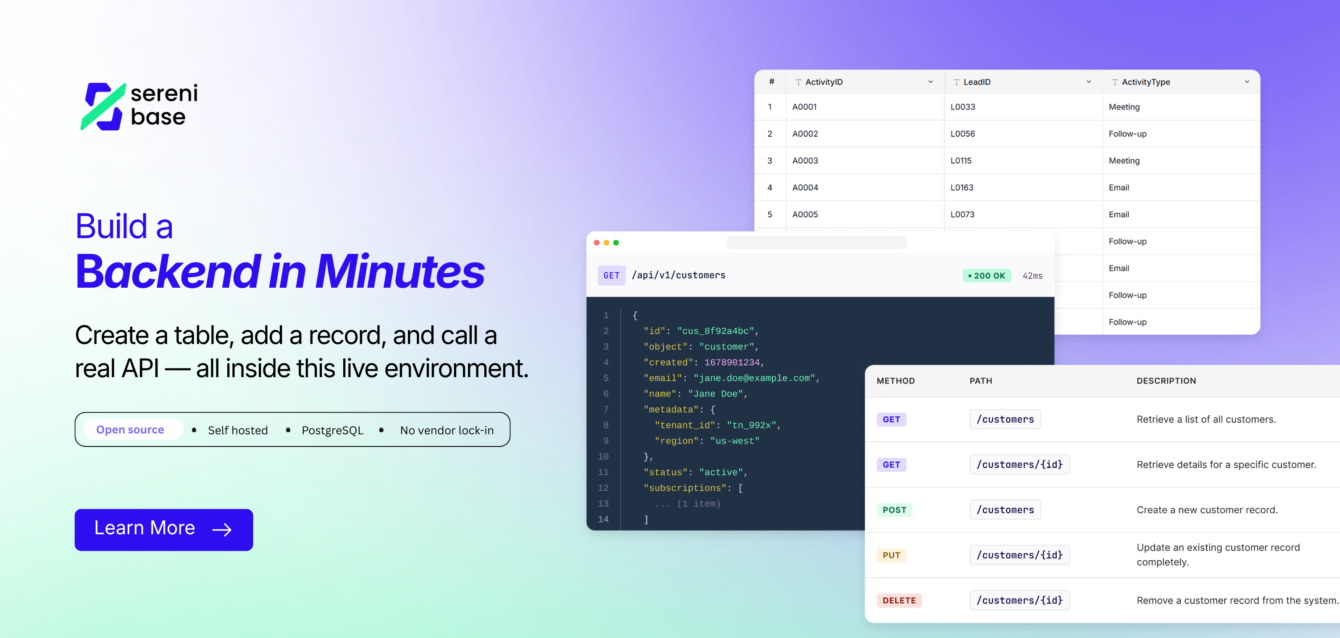
You can also try the live demo to experience the create-table-to-REST-API workflow.
To know more you can reach out to us at sales@aptlogica.com