


As an L&D Manager, you can probably see who completed a course.
But can you see what happened between “started” and “completed”?
That gap exists because most learning platforms record one outcome per learner per course. xAPI works differently: it records learning as individual statements — someone did something — so the detail between start and finish survives.
The question matters more every year. In 2026, data analytics and reporting was identified as a critical capability by 56% of L&D leaders surveyed.
The message is clear. The future of L&D isn’t just about delivering more learning. It’s about understanding what your learning data is telling you.
Introducing Sereni LRS by Aptlogica
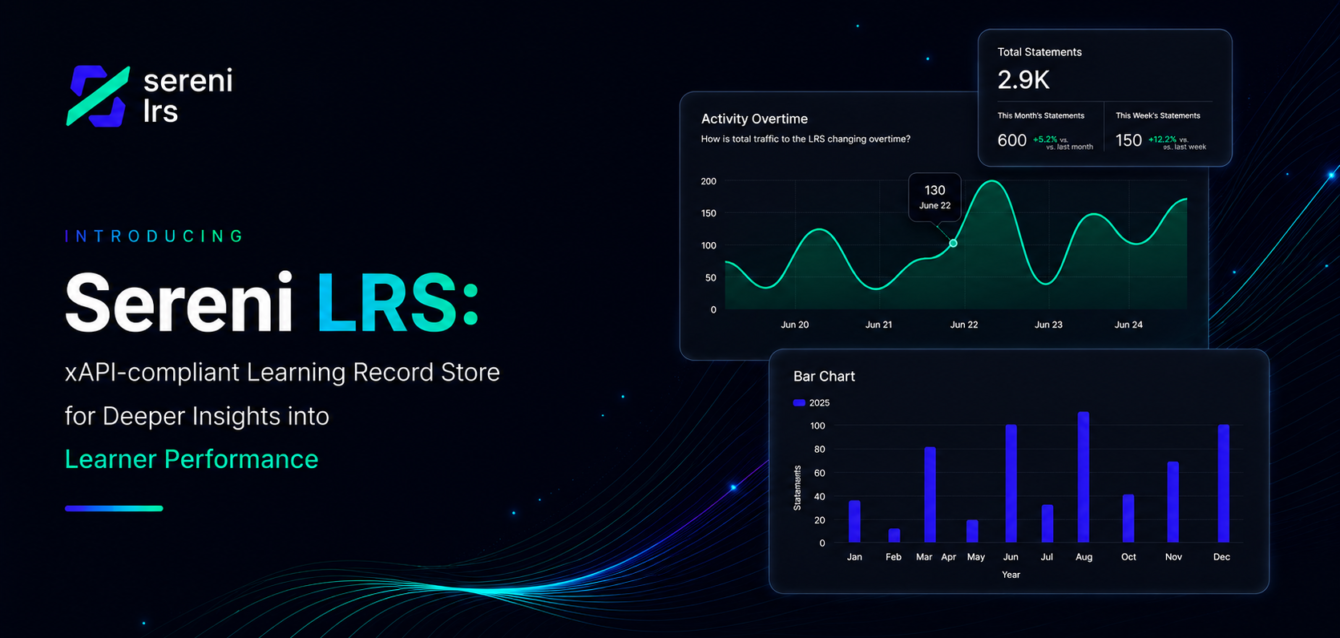
Aptlogica recently launched Sereni LRS, an xAPI Learning Record Store that helps you capture, store, explore and analyse learning activity data.
Your learning data shouldn’t just be stored. It should be usable.
An LRS is where learning records live — a place to receive, store and access the data generated through xAPI.
But when we designed Sereni LRS, we wanted to go further than giving you somewhere to send your xAPI statements.
We wanted teams to be able to see their data, explore it, analyse learner activity, and turn those records into decisions.
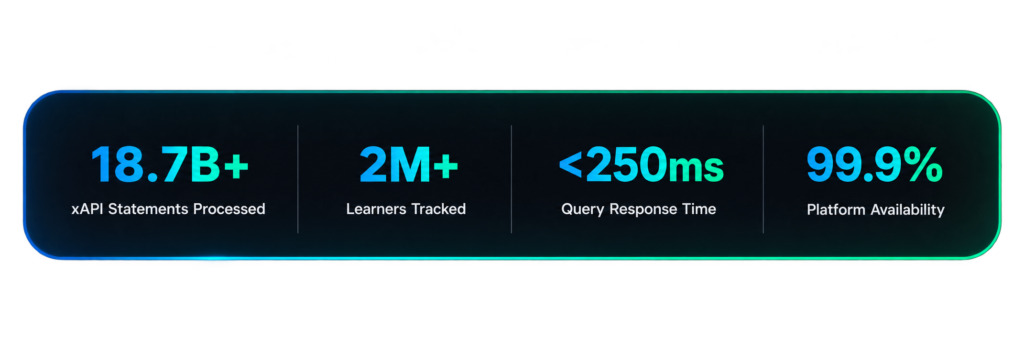
That’s what Sereni LRS brings together — on infrastructure that has processed more than 18.7 billion xAPI statements across 2 million+ learners, with
250ms query response and 99.9% platform availability.
You don’t need to replace your LMS
This is the part most teams don’t realise.
If your LMS only supports SCORM, xAPI is not out of reach. You can keep publishing SCORM exactly as you do today, and — in the same publish settings in Storyline, Captivate or Lectora — also point the course at an external Learning Record Store.
Your LMS keeps receiving its completion data. Sereni receives the xAPI statements underneath it. No migration. No new LMS. No procurement fight. You just needed somewhere for the data to go.
If your LMS does support cmi5, publishing to cmi5 gives you richer data still — but it isn’t a prerequisite for getting started.
Sereni fits the learning stack you already have
Adopting an LRS shouldn’t mean replacing every learning system around it. Sereni sits inside your existing ecosystem, receiving xAPI statements from the places where learning and assessment already happen.
Sereni receives data from LMSs, LXPs, mobile applications, virtual classrooms, simulations, assessment systems and custom learning platforms. It can also make that data available to your HR systems, business intelligence tools and internal applications through REST APIs.
The result is a common learning-data layer across your stack, while each system keeps its own delivery and user-experience role.
Sereni is available as cloud or self-hosted deployment, with role-based access control, so it can meet the security and data-residency requirements your IT team will ask about.
Beyond what LMS reporting can do
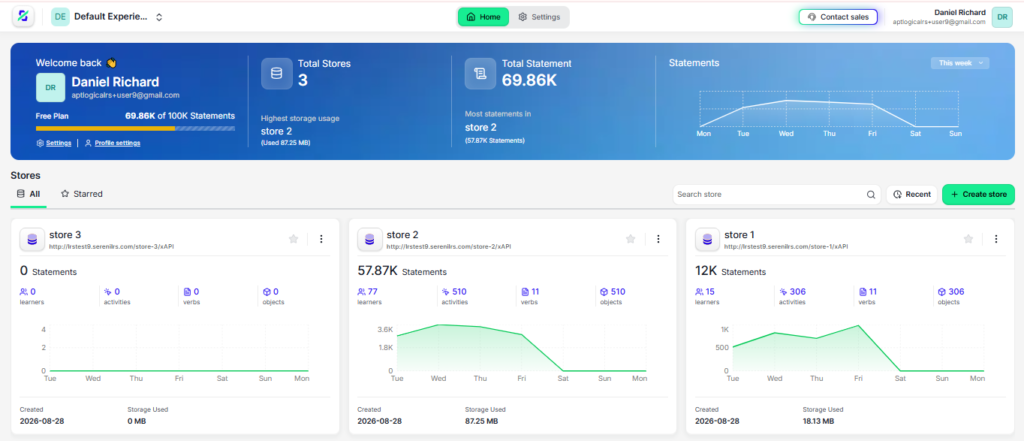
1. Manage multiple learning-data stores from one workspace
Sereni LRS gives you a store-level view of statement volume, learners, activities, verbs, objects, storage and recent activity. You can see where data is accumulating, which stores are active and how volumes are changing — before opening a detailed report.
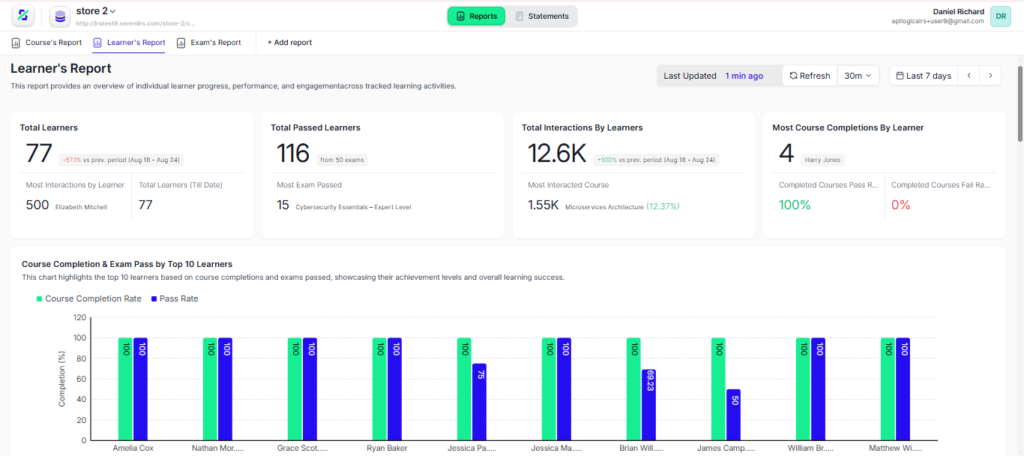
2. Understand the learner journey beyond completion
Learner reports bring together activity, completions, performance, interactions, duration, attempts and competency evidence. A chronological learner transcript can include the actor, verb, object, timestamp, result, score, duration, registration and originating platform.
That gives your support, compliance and L&D teams a far more complete record than a single completion field.
3. Find out where learners struggle, not just who passed
Sereni shows you where learners disengage, retry or run into difficulty. Track progress stages, score patterns, attempts, pass/fail results and question-level outcomes.
Your least-completed course is often more useful than your most-completed one — it tells you where to spend your next redesign cycle.
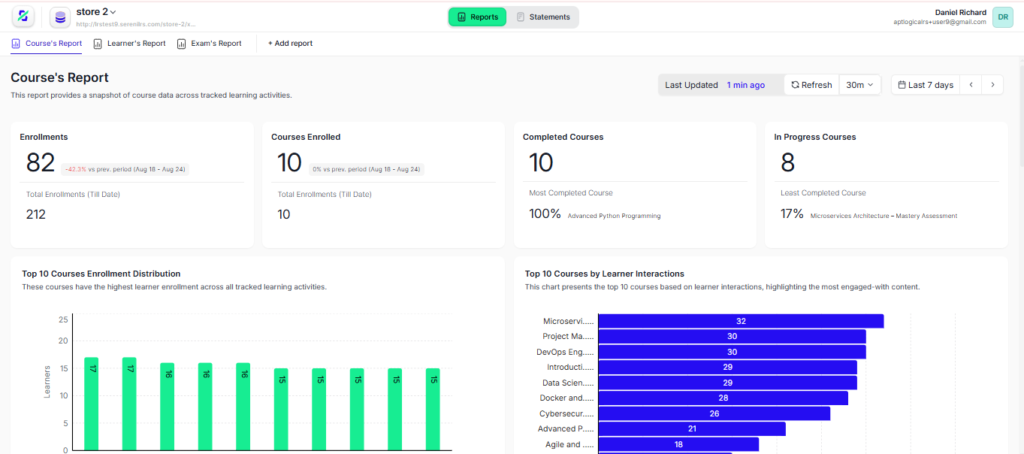
4. Compare performance and monitor data health
Sereni compares learning activity across cohorts, departments and regions. It also monitors ingestion, validation, duplicates, latency and data quality — so you find a broken integration before it quietly distorts a quarter of reporting.
A note on what any LRS can show you.Cohort comparison, question-level detail and competency evidence all depend on the statements your source systems actually send. Where the required xAPI data or metadata isn’t present, those views can’t be populated. Sereni’s data-health monitoring exists precisely so you can see what’s missing rather than discover it in a board report.
Seamless Learning Locker migration
If you’re already running Learning Locker, Sereni includes a dedicated MongoDB Import Utilitythat imports historical xAPI statements directly from your existing database. Every statement is validated, processed and preserved, so your team can move across without losing years of learning history.
- Migrate historical xAPI statements
- Preserve learning history and data integrity
- Reduce manual migration effort
- Continue analytics without data loss
From raw xAPI statements to something people can actually use
One of the biggest advantages of xAPI is the sheer amount of detail it captures.
A statement isn’t just “Daniel completed Course X.”
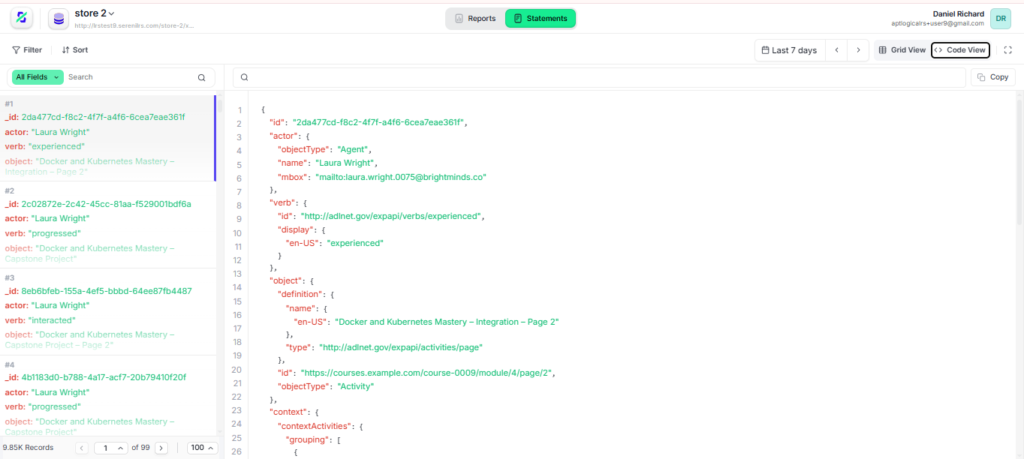
An xAPI statement can carry an actor, verb, object, result, context, timestamp and more, depending on the experience. The specification describes statements as evidence of experiences or events that can be aggregated and analysed to create meaning beyond the individual event.
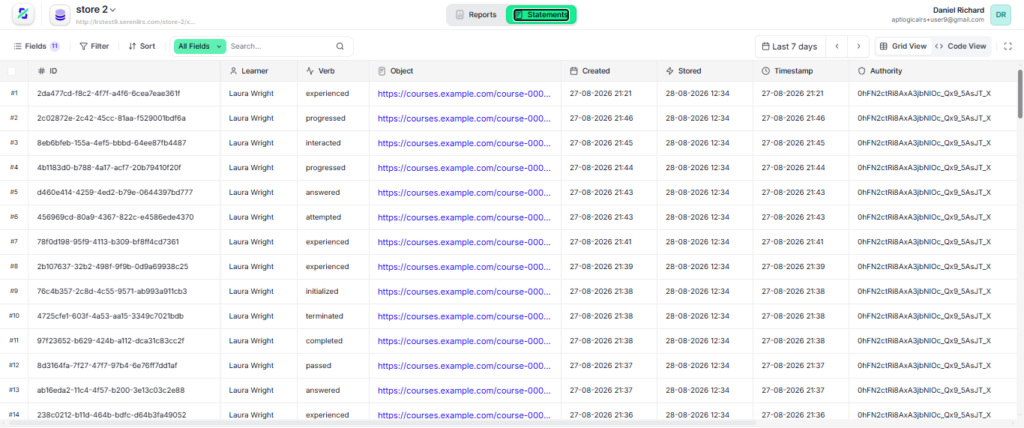
Sereni gives you two ways to work with those records, and most teams use both:
Grid View: turns statements into a sortable, filterable table — learner, verb, object, timestamp, authority — so you can scan thousands of records, filter to a single verb or learner, and find the pattern you’re looking for without writing a query.
Code View: shows you the complete raw JSON of any statement, exactly as it was received. This is where your developers and integration partners confirm that a source system is sending what it should, and debug it when it isn’t.
Start with the free plan. Grow when you need to.
Not every organisation needs the same infrastructure on day one.
Sereni LRS has a free plan that includes up to 100,000 xAPI statements— enough to connect a real course, send live data and see what your own learning activity actually looks like before you commit to anything. Paid plans scale from there as your data and requirements grow.
Create a free accountand start exploring your learning data today.
For enterprise deployments, migrations or a walkthrough, reach us at sales@serenilrs.com